
Transylvania · Sighișoara
Sighișoara's citadel
A hilltop citadel where people still live and go to school, with a painted Clock Tower, a covered stairway to a Gothic church, and towers named for the guilds that held them.
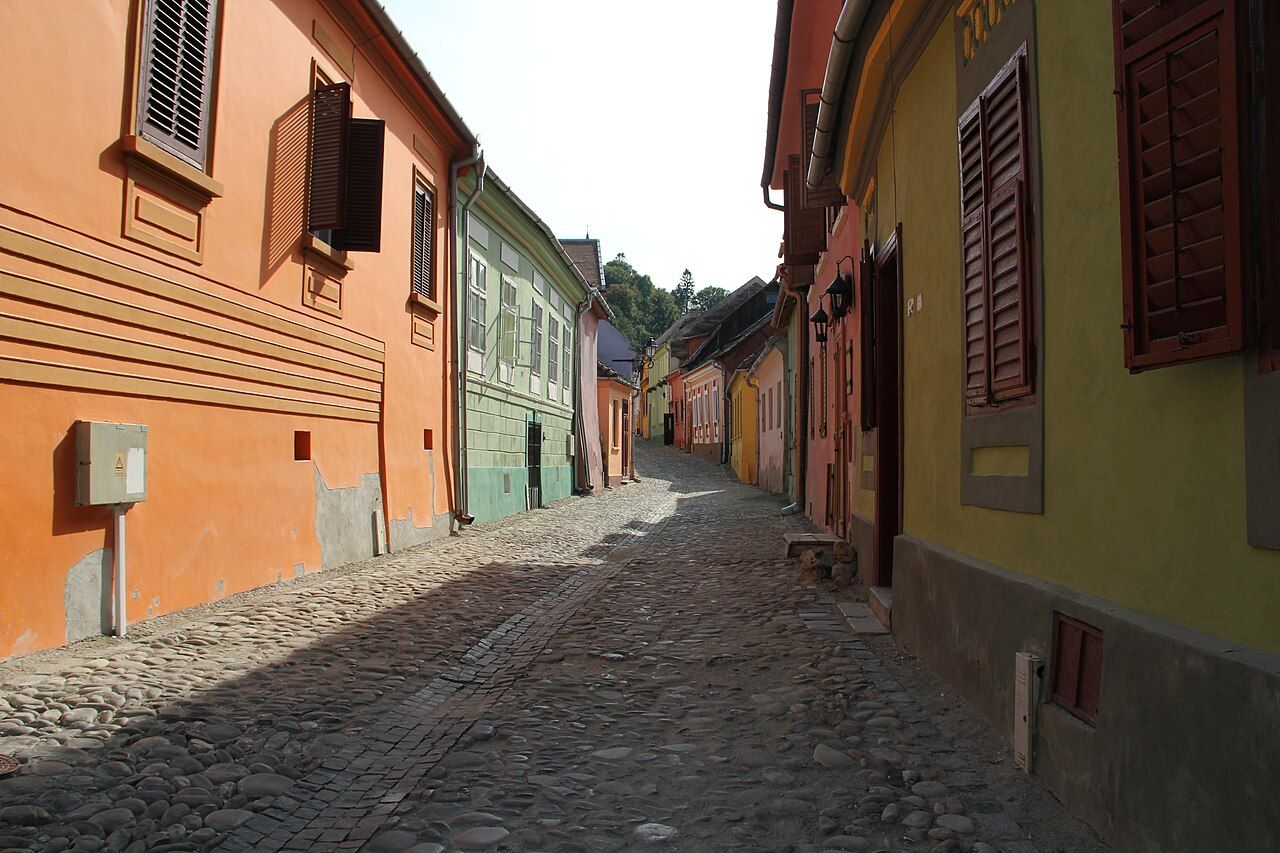
Sighișoara stands above the Târnava Mare river in the middle of Transylvania, with its walled upper town on a hill and the lower town spread along the water below. Its Saxon founders called it Schäßburg, and the citadel they built and kept up over several centuries is one of the few medieval fortified towns in Europe that is still lived in. People have homes, schools and a church inside the walls, and washing hangs to dry a few streets from the Clock Tower. The historic centre was added to the UNESCO World Heritage List in 1999, and the listing covers the citadel as a whole rather than a single monument.
The town is small, and most visitors give it a few hours. It repays more: a night inside or near the walls lets you see the streets early and late, when they are quiet and the light is low on the painted walls.
The Clock Tower
The Clock Tower, Turnul cu Ceas, guards the main gate into the citadel and is the symbol of the town. It was built in the 14th century and raised and rebuilt later, and it carries a tall roof of coloured tiles with small corner turrets. The clock has carved wooden figures that change with the days of the week, a reminder of how much the town invested in showing its wealth at the gate. Inside, the tower holds the town history museum, and a climb through its floors brings you to a wooden gallery at the top, with views over the citadel roofs, the lower town and the hills around.
Inside the walls
The citadel's main streets run along the top of the hill from the Clock Tower to the far end, and you can walk all of them in an hour. Do it slowly. The houses are painted ochre, green, pink and blue, with heavy wooden doors, iron fittings and shutters, and many were rebuilt in the 17th century after fires. Piața Cetății, the citadel square, is the small open space at the centre where markets and gatherings were held.
Near the Clock Tower, a house carries a plaque saying that Vlad III, the prince later known as Dracula, was born there around 1431. His father, Vlad II Dracul, lived in Sighișoara in those years while he waited for his chance at the throne of Wallachia, and the tradition of the birth is old, though it cannot be proved. Vlad III ruled Wallachia, south of the mountains, not this town. The souvenirs on sale around the citadel owe more to Bram Stoker's 1897 novel, written by a man who never came to Romania, than to the 15th-century prince, and the town has far more to show than one disputed birthplace.
Further along the arcSibiu, the town with eyes in its roofsThe Schoolboys' Stair and the church on the hill
From the citadel square, the covered stairway called Scara Școlarilor, the Schoolboys' Stair, climbs the steepest part of the hill under a wooden roof. It was built in 1642 so that pupils could reach the school at the top in winter without slipping on snow and ice, and it has well over a hundred steps. At the top stand the school, still in use, and the Church on the Hill, Biserica din Deal, a large Gothic Lutheran church built over the 14th and 15th centuries, with remains of wall paintings inside. It usually opens to visitors in the warmer months; check before you climb.
Beside the church, the old Saxon cemetery runs down the slope among trees, with German names on its stones. It is a quiet place and is still in use, so keep to the paths and leave the graves as they are.
The guild towers
As in the other Saxon towns, Sighișoara's defences were divided between its guilds. Each tower was named for the craft that built it, kept it supplied and fought from it in a siege. Nine towers survive along the walls, among them the Shoemakers' Tower, the Tailors' Tower, the Tinsmiths' Tower, the Ropemakers' Tower and the Butchers' Tower. The Tailors' Tower stands over the second gate into the citadel. A path runs around much of the outside of the walls, and walking it is the best way to see the towers, the slope of the hill and the lower town below.
In the lower town, across the river, the white Orthodox cathedral of the Holy Trinity was built in the 1930s in a Byzantine style. It is a short walk from the citadel and shows the Romanian side of a town that, like much of Transylvania, was long shared by Saxons, Romanians and Hungarians.
Practical notes
Sighișoara lies on the railway between Brașov and Cluj-Napoca, and on the road that links them. Train and bus times change, so check them before you set out. A medieval festival is held in the citadel most summers, bringing music, costumes and big crowds; check the dates whether you want to see it or avoid it.
The streets are cobbled and steep, and the Schoolboys' Stair can be slippery when wet. The citadel has no great distances, but it has many slopes and steps, so plan rests if walking is hard for you. Sighișoara is also a good base for the Saxon fortified churches in the villages around it, including Saschiz, Biertan and Viscri, which are within an hour or so by road.
The photographs on this page are credited, with their licences, on threads and photographers.